




General Overview:
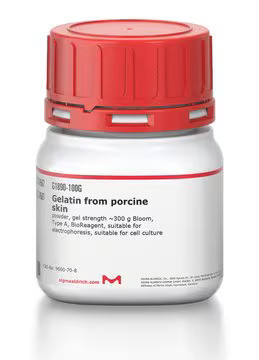
Gelatine is a natural hydrocolloid derived from collagen, typically sourced from porcine or bovine materials such as bone and hide. This product is obtained from porcine skin and is classified as Type A gelatine, produced via acid hydrolysis. It consists primarily of protein, along with minor amounts of minerals and water.
Applications:
Porcine skin-derived gelatine is a versatile biomaterial used across a wide range of scientific and industrial applications, including:
Coating glass-bottom plates for culturing A375 cells and for use in gelatine degradation assays
Preparing coated slides for histological studies, particularly involving brain tissue sections
Synthesising gelatine methacrylate (GelMA) prepolymer for encapsulating cells in 3D-printed hydrogels
Producing thiol-functionalised gelatine (GelSH) hydrogels for 3D projection bioprinting
Recommended usage as a cell culture substrate ranges from 1–5 μg/cm² or 0.5–50 μg/mL, depending on the cell type, application, and research goals.
Biochemical/Physiological Properties:
Gelatine serves as a biocompatible and biodegradable alternative to collagen in tissue and cell culture applications. Outside the laboratory, it is widely employed as a gelling agent, thickener, stabiliser, foaming agent, and binder in food and pharmaceutical products. In biomedical research, it is particularly valued for its role in cardiac and vascular tissue engineering.
Solubility & Preparation Notes:
Soluble in hot water; limited solubility in cold water
Practically insoluble in most common organic solvents, such as alcohols, ethers, and oils
This product has a Bloom strength of 300, indicating high gel strength and molecular weight
Soluble in water at concentrations up to 50 mg/mL
Additional Information:
Type A gelatine is acid-processed; Type B (not this product) is lime-processed
Gelatine is a heterogeneous mixture of high molecular weight, water-soluble proteins extracted by boiling collagen-rich tissues in water
Storage & Stability:
When stored in airtight containers at room temperature, dry gelatine remains stable for many years. Heating to 100°C in the presence of air causes degradation, resulting in the evolution of pyridine bases and ammonia, and the formation of a carbonaceous mass.
Safety & Handling:
Storage Class Code: 11 – Combustible Solids
WGK Classification: nwg (non-hazardous to water)
Flash Point: Not applicable
Recommended PPE: Gloves, N95-type dust mask (or equivalent), and protective eyewear when handling dry powder
Awards & Recognition:
2024 CiteAb Award Winner – Recognised as a leading supplier supporting Parkinson’s research
General Overview:
Gelatine is a natural hydrocolloid derived from collagen, typically sourced from porcine or bovine materials such as bone and hide. This product is obtained from porcine skin and is classified as Type A gelatine, produced via acid hydrolysis. It consists primarily of protein, along with minor amounts of minerals and water.
Applications:
Porcine skin-derived gelatine is a versatile biomaterial used across a wide range of scientific and industrial applications, including:
Coating glass-bottom plates for culturing A375 cells and for use in gelatine degradation assays
Preparing coated slides for histological studies, particularly involving brain tissue sections
Synthesising gelatine methacrylate (GelMA) prepolymer for encapsulating cells in 3D-printed hydrogels
Producing thiol-functionalised gelatine (GelSH) hydrogels for 3D projection bioprinting
Recommended usage as a cell culture substrate ranges from 1–5 μg/cm² or 0.5–50 μg/mL, depending on the cell type, application, and research goals.
Biochemical/Physiological Properties:
Gelatine serves as a biocompatible and biodegradable alternative to collagen in tissue and cell culture applications. Outside the laboratory, it is widely employed as a gelling agent, thickener, stabiliser, foaming agent, and binder in food and pharmaceutical products. In biomedical research, it is particularly valued for its role in cardiac and vascular tissue engineering.
Solubility & Preparation Notes:
Soluble in hot water; limited solubility in cold water
Practically insoluble in most common organic solvents, such as alcohols, ethers, and oils
This product has a Bloom strength of 300, indicating high gel strength and molecular weight
Soluble in water at concentrations up to 50 mg/mL
Additional Information:
Type A gelatine is acid-processed; Type B (not this product) is lime-processed
Gelatine is a heterogeneous mixture of high molecular weight, water-soluble proteins extracted by boiling collagen-rich tissues in water
Storage & Stability:
When stored in airtight containers at room temperature, dry gelatine remains stable for many years. Heating to 100°C in the presence of air causes degradation, resulting in the evolution of pyridine bases and ammonia, and the formation of a carbonaceous mass.
Safety & Handling:
Storage Class Code: 11 – Combustible Solids
WGK Classification: nwg (non-hazardous to water)
Flash Point: Not applicable
Recommended PPE: Gloves, N95-type dust mask (or equivalent), and protective eyewear when handling dry powder
Awards & Recognition:
2024 CiteAb Award Winner – Recognised as a leading supplier supporting Parkinson’s research

